Anorith and Armaldo
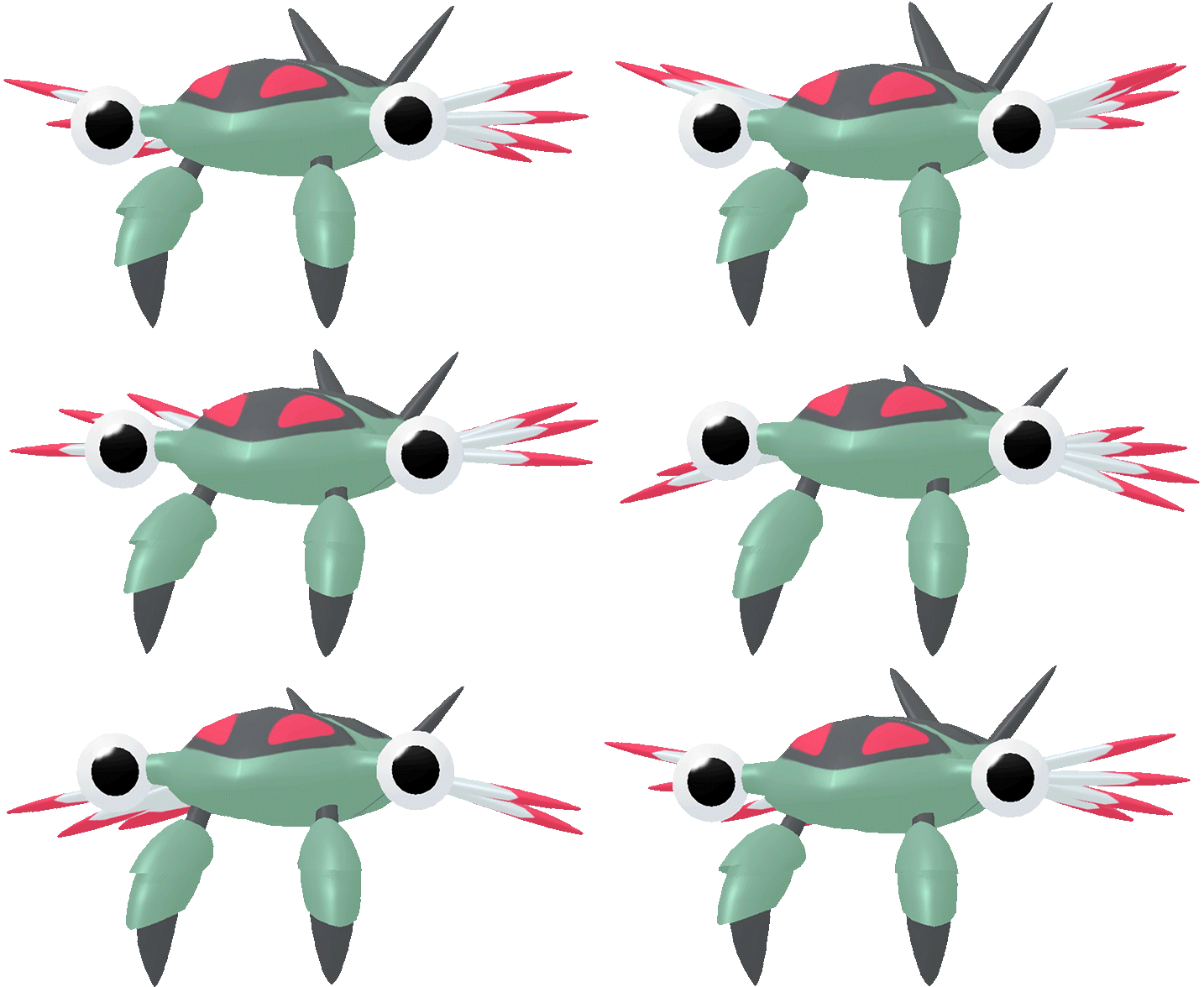
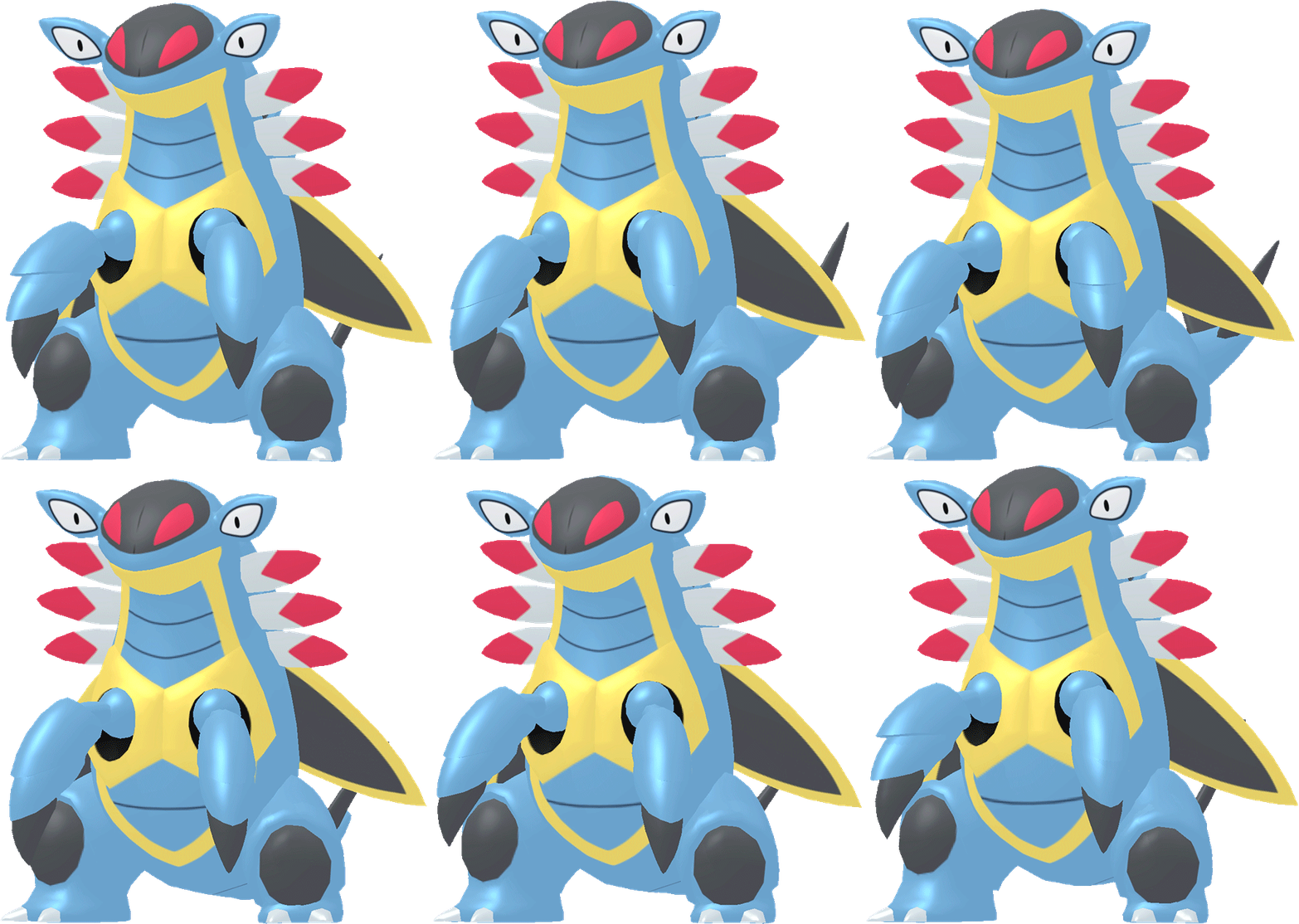
| Name: | Type: | Fossil: |
|---|---|---|
| Anorith and Armaldo | Rock/Bug | Claw Fossil |
Anorith and Armaldo are one of the first new fossils introduced after the initial set, and one of two new fossil lines introduced in Gen III. Similar to Gen I, you had the option to choose which fossil you wanted (either Claw or Root), and the other would become unavailable, requiring trade or another playthrough to get.
This line resembles radiodonts, most specifically Anomalocaris, an ancient Cambrian arthropod, and one of the most emblematic of the time period. Anorith is the closest in resembling this creature, while Armaldo is more of a monstrous version of one. Although they are both Bug/Rock types, they have a lot of Water moves and adjacent abilities, likely to reference the fact Anomalocaris was a marine creature.
The Gen III fossils continue the Gen I trend of using less well-known ancient invertebrates instead of the more charismatic vertebrates such as dinosaurs (with Aerodactyl as an exception.)
Pokemon Design
Anorith and Armaldo are intriguing Pokemon designs that really exemplify the design philosophy of Gen III. The art direction for this generation was helmed by Hironobu Yoshida, a designer who helped make Dunsparce, Celebi and Wobbuffet—though we don’t have confirmation on if he designed this line. However, knowing that, you can really see how his style shapes the third generation’s Pokedex—a lot of wild ideas and design elements, along with bold colours and patterns, which are all over both of Gen III’s Fossil Mons.
Anorith is very clearly an Anomalocaris, but it has enough differences to make it stand out as its own monster. The feathery flaps on its side are an interesting touch—and indeed, many Pokedex entries reference “wings” for both of these Pokemon, though it doesn’t really do much else with this imagery. Anorith also has the iconic frontal appendages that made Anomalocaris stand out, and even has a circular mouth on its underside, like its inspiration. And it has such big, cute eyes!
Armaldo, however, takes it up a notch. Following in the footsteps of Kabutops, it looks almost as if you combined an Anomalocaris with a dinosaur, making it still feel like an ancient beast, but also something all on its own. I love the diamond-shaped eyes whose placement still evoke eye stalks, along with the chunky feet, and the long, pronged tail!
I love these Pokemon dearly, they are some of my favourite Fossil Mons, though I do feel they can be a little busy. Armaldo’s “wings” (in this case, the flaps on its back) feel a little extra. I remember as a child attempting to draw this Pokemon, but all the details made it quite difficult to get right. But maybe that’s ultimately the charm of this Pokemon—as well as all of the conceptually busy Pokemon of Gen III. Armaldo is an Anomalocaris dinosaur with feathers, wings, and fangs. In the end, I guess you can’t go wrong with such a unique take on a monster like this!
Paleo Profile
Radiodonts were strange, early arthropods that swam the seas all the way from the Cambrian possibly to the Devonian. Anomalocaris is the most well known of this group, though its discovery took many years of putting together pieces to get the whole picture—for a long time we only had mouth parts and pieces of its arms. I can hardly blame it for taking so long, because Anomalocaris is a weird creature. A worm-like body with undulating flaps, two huge eyes on stalks, and a pair of appendages on its head that act as its arms to help it feed. It’s practically alien!
Anomalocaris is thought to be one of the first apex predators in the very early beginnings of animal life. It was quite large compared to many of the other creatures living at the time, and is speculated to have used its arms to grab prey, bring them to its mouth, and crunch them up. For a time it was thought this would be hard-shelled creatures like trilobites, but recent studies have taken a closer look at the structure of Anomalocaris’s mouth, and realized that might not be the case. It’s possible it might have preyed on soft-bodied creatures instead, as its mouth was built better for suction than for crushing.
Anomalocaris is probably the biggest and most well known representative of the Cambrian Period in popular culture. Picturing one is almost synonymous with the Cambrian itself. It is truly a bizarre, but charismatic creature—something about it being so odd looking, but having the “cool factor” of it being Earth’s first apex predator, really makes it shine. I’m glad it gets so much love, as a truly unique animal—enough so that it also made its way to being its own Pokemon, too.
Anorith and Armaldo are a pair of odd Pokemon based off of an odd creature, and in that sense I wouldn’t have it any other way. Armaldo being a theropod beast with elements of an Anomalocaris is so fun and original, I honestly wish I had thought of it!
Misc. Trivia
- Armaldo’s sprites remain pretty much exactly the same through its whole existence, until moving into 3D. Its sprites are also coloured a more purple-y blue, instead of the bold blue of its official art.
- One of Anorith’s dex entries states it lived “about 100,000,000 years ago.” The real Anomalocaris lived about five-hundred million years ago, so the numbers are a little off. One-hundred million years ago puts Anorith in the Jurassic.
- The Claw Fossil is apt for this Pokemon, as Anomalocaris was once only known from its front claws. In fact, its name means “strange shrimp”, as it was thought that these claws were in fact the segmented body of a shrimp!
- I’d be remiss not to link a very important video here—the classic, A Tribute to Anomalocaris.
